
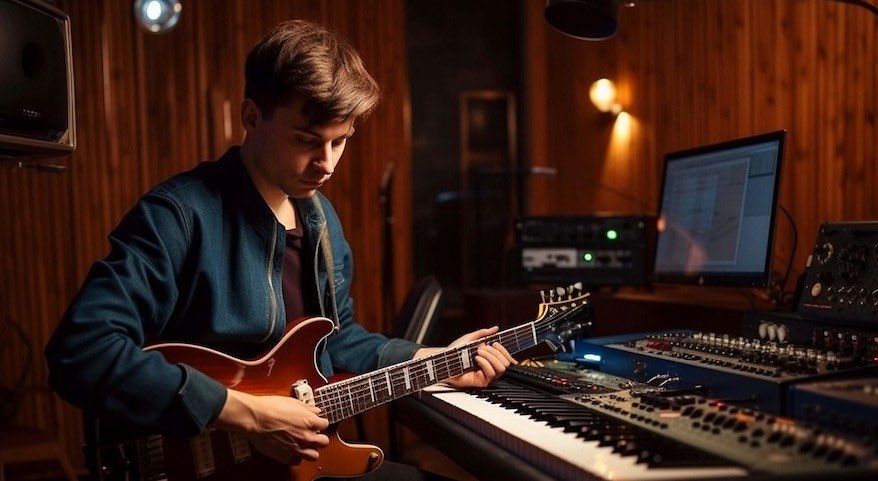
Gone are the days when the only way to record a great
album was to go to a high-profile, expensive recording
studio. Music technology has advanced so much in the past
few decades that now, you can record your music to radio
quality standards right from your own bedroom! If you’re a
working musician on a budget, there are only a few
essentials you need to get started.
1. A Computer
To start, any computer will do, so long as it has a
minimum of four gigabytes of RAM. As of 2025, most
computers come with at least eight gigs of RAM standard.
Most recording software requires at least four gigs, but
some programs require more. Ideally, you need a minimum of
eight gigs of RAM and at least a quad-core processor to
allow your software to run smoothly and without crashing.
You can use either a PC or Mac, but that choice will
depend on which system you are more comfortable with and
what your software requires in terms of compatibility.
2. An Audio Interface
In a commercial studio, the “audio interface” is a piece
of equipment that converts audio signals from a microphone
or other audio source into digital audio. Your computer
processes everything digitally, so you need an audio
interface in order to do any recording (unless you’re
old-school and have an analog tape recorder). Audio
interfaces used to be big, clunky, and expensive, but in
recent years many companies have started making smaller,
more affordable units specifically designed for small
project studios. They can come with as little as one or
two microphone inputs or as many as thirty-two or even
more. They typically plug into your computer via USB cable
and act as an external sound processing unit. Make sure to
update your audio settings on your computer when
installing your audio interface, as your computer will use
its own built-in audio card by default.
3. A Microphone
Of course! How else do you expect to capture sound? There
are a few different types of microphones that serve
different purposes, but they all essentially do the same
thing: capture sound and turn it into audio. For most
purposes, a standard dynamic microphone works. They are
relatively inexpensive and pretty much plug-and-go. The
Shure SM58 has been an industry standard vocal performance
microphone for decades and goes for between $90 to $100
brand new. If you want something that can pick up delicate
or high-pitched sounds in finer detail try out a condenser
microphone. These tend to be a little more expensive than
dynamic mics, but the price range is quite wide and you
can find them for between $100 to $3,000. There are some
subtle differences in features and capability between
models, so it’s worth doing your homework. Condenser mics
require forty-eight volts of “phantom power” to function.
Make sure your audio interface has this feature or else
your condenser mic will not work.
If you’re a working musician on a budget, there are only a few essentials you need to get started.
4. Digital Audio Workstation Software
Have you ever heard of “Pro Tools”? It was the industry
standard software for recording audio for many years and
is still used today by most commercial enterprises. A
digital audio workstation (or DAW for short) is a software
program used for recording and processing audio and music
written using digital programming. If you’re trying to
produce any kind of modern music, you need one of these.
DAWs vary in price and there are many different types each
designed for different music production methods. DAWs like
Pro Tools, Cubase, and Logic are well-rounded for general
purpose audio production, whereas Ableton and
Propellerhead’s Reason are more suited toward electronic
music production. Some audio interfaces even come with
their own starter version of a DAW. Whichever DAW you
choose, it’s a good idea to stick with one, as they
generally have a steep learning curve and attempting to
learn multiple types at once can be difficult, tedious,
and time-consuming.
5. Speakers/Headphones
Finally, we need some way to hear the audio we are
capturing, or we won’t be able to do anything with it! A
pair of studio speakers will take dual-mono outputs from
your audio interface and replicate a stereo mix of your
audio in the room. Studio speakers come in different
sizes, form factors, and prices. Having a stereo-matched
pair of speakers is ideal when working on a mix, they give
you the most clarity in your sound. If you’re worried
about making too much noise for the neighbors, or if your
singer just needs to be able to hear themselves better in
a recording session, try a pair of stereo headphones.
Ideally, a pair of closed-back, over-ear headphones is
best for hearing audio clearly and for blocking out
background noise from the environment. Avoid
bluetooth-based solutions, as they are less reliable
overall and don’t provide the same level of sonic clarity
as wired speakers or headphones.